Thermomigration and Intermetallic Phase Shifts in Ultrasonic Sonotrodes under High Current Density Operations
High current density ultrasonic sonotrodes degrade through coupled thermomigration and intermetallic embrittlement, requiring strict wear-limit replacement protocols.
Knurl
Ultrasonic sonotrode tips contact battery tab surfaces under dynamic normal forces between 150 and 800 newtons, delivering 20 to 40 kilohertz of transverse shear displacement while simultaneously transmitting direct-current pulses exceeding 50 kiloamperes per square centimeter. The contact teeth undergo rapid cyclic mechanical scrubbing against soft aluminum 1050 or nickel-plated copper C11000 workpieces. Acoustic energy couples through the serrated tool pattern to break up surface oxides.
When electrically assisted welding routines introduce current densities beyond 100 kiloamperes per square centimeter to lower the required acoustic bonding threshold, the tool face enters a coupled mechanical, thermal, and electrodynamic regime. Joule heating combines with acoustic friction, raising the micro-asperity interface temperature beyond 650 kelvin within 150 milliseconds.
Tooth profile geometry determines electrical contact resistance during the initial clamping interval before vibration begins. Standard sonotrode patterns feature pyramid or chisel teeth with 60-degree to 90-degree tip angles, heights between 0.15 and 0.45 millimeters, and tip plateau radii held within 0.03 plus or minus 0.005 millimeters. As the sonotrode sinks into the tab stack, current concentrates at the perimeter of individual tooth plateaus, where peak current densities often exceed the macroscopic average by an order of magnitude.
This localized constriction drives intense ohmic dissipation at microscopic contact points. Mechanical scrubbing simultaneously shears native aluminum and copper surface films, creating pristine metallic junctions that weld momentarily before tearing away during vibration cycles.
Normal clamping forces below 200 newtons permit micro-arcing at tooth perimeters, accelerating local interfacial melting.
When excessive current softens the workpiece too quickly, acoustic resonance wanders out of tolerance as the mechanical impedance load presented to the transducer drops abruptly. The piezoceramic stack experiences an anti-resonance shift, pulling the power supply frequency beyond its phase-locked loop tracking window. The generator then cuts acoustic amplitude to protect its output switching transistors, leaving the high-amperage current pulse running through a quasi-static interface without vibrational oxide dispersion.
Weld quality degrades instantly under this mismatched condition.
The progression through an electrically assisted ultrasonic bond follows five tightly sequenced intervals:
- Mechanical pre-compression establishes contact across the tab stack under pneumatically or servomechanically driven knurl engagement, stabilizing macro-scale contact resistance across the sonotrode face.
- High-current initiation injects a conditioning pulse between 40 and 120 kiloamperes per square centimeter, softening tab asperities through resistive heating before acoustic amplitude ramps.
- Acoustic scrub activation triggers vibrational amplitude between 15 and 45 micrometers, dispersing fractured oxide debris away from tooth crests while continuous current flows across newly established pure-metal junctions.
- Solid-state diffusion coalescence occurs under simultaneous peak temperature and transverse plastic flow, driving metallurgical consolidation across the foil layers without macroscopic bulk liquid expulsion.
- Hold-down solidification maintains clamping force without current or vibration for 80 milliseconds, cooling the bonded tab stack and allowing the sonotrode to disengage without tearing fresh joint interfaces.
Thermal dissipation across the sonotrode horn relies on high thermal conductivity paths extending through the titanium or powdered metallurgical tool body. A sonotrode manufactured from standard Ti-6Al-4V exhibits a thermal conductivity of roughly 6.7 watts per meter-kelvin at room temperature, which traps heat near the working knurl face. By contrast, sonotrodes manufactured from tungsten-carbide cobalt composites or dispersion-strengthened copper alloys conduct heat rapidly into the tool shank, holding peak knurl tooth temperatures below critical phase transformation thresholds during high-takt production cycles.
Tool selection fixes the boundary between stable solid-state bonding and catastrophic thermal runaway.
Transport
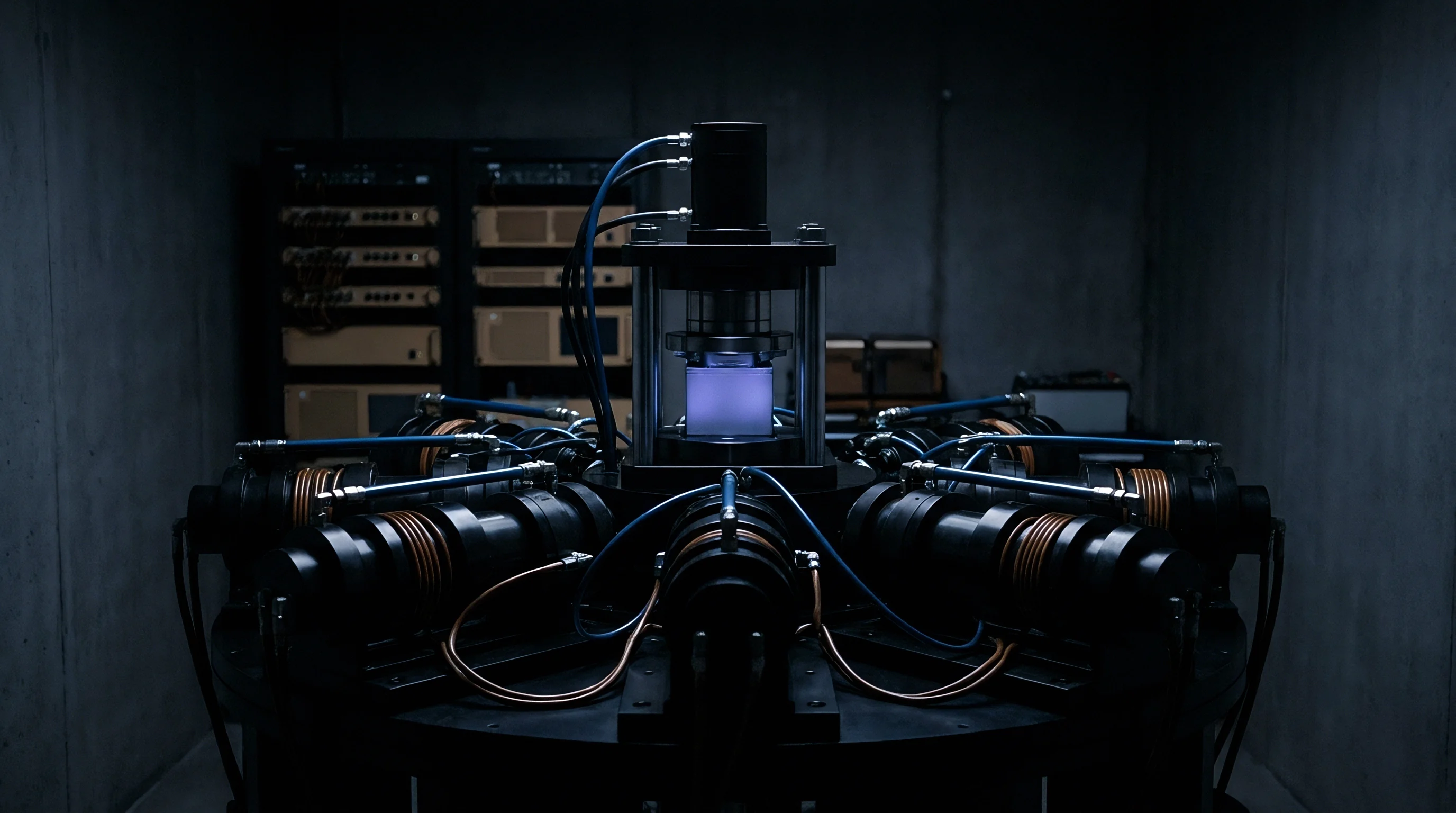
What Triggers Atomic Migration across Sonotrode Faces?
Mass transport across the sonotrode-tab boundary operates under simultaneous electrical potential gradients and steep spatial temperature fields. High current densities generate an electron wind that exerts directional momentum transfer onto lattice ions, driving electromigration. Concurrently, thermal gradients exceeding five kelvin per micron establish an intense driving force for Soret-effect thermomigration.
In typical battery pack welding lines coupling resistive preheating with ultrasonic energy, the temperature gradient between the knurl tip and the internal water-cooled horn body drives rapid net atomic flux.
Under these conditions, the atomic flux equation incorporates chemical activity gradients, electromigration forces, and thermomigration contributions. The thermomigration flux depends directly on the net heat of transport of the diffusing species, the local diffusion coefficient, and the temperature gradient across the sonotrode-tab contact interface. When the heat of transport is negative, atoms migrate preferentially toward hotter regions; when positive, atoms move toward cooler heat sinks.
In aluminum foils clamped by tungsten carbide sonotrodes, aluminum atoms exhibit a negative heat of transport, pulling aluminum mass into the micro-cavities and grain boundary recesses of the hot sonotrode teeth.
| Material Couple | Current Density (kA/cm²) | Thermal Gradient (K/µm) | Heat of Transport (kJ/mol) | Dominant Driving Mechanism |
|---|---|---|---|---|
| WC-6Co on Al 1050 | 85 | 6.2 | -12.4 | Thermomigration toward knurl tip |
| WC-6Co on Cu C11000 | 110 | 4.8 | +8.2 | Electromigration toward anode tab |
| Ti-6Al-4V on Al 1050 | 60 | 7.5 | -15.1 | Thermomigration into tool face |
| GlidCop AL-15 on Cu C11000 | 140 | 2.1 | +5.4 | Electromigration along grain boundaries |
With diffusion rates tripling under elevated flux, cobalt binder in WC-Co sonotrodes represents the most vulnerable metallurgical pathway during high current density pulses. Pure cobalt exhibits a high affinity for liquid and solid-state aluminum at temperatures above 550 kelvin. Electromigration forces push cobalt atoms toward the cathode terminal of the welding circuit, while the thermal gradient created by frictional knurl dissipation pulls aluminum atoms upward into the depleted cobalt voids.
The resulting interdiffusion leaches the structural binder from the cemented carbide matrix, leaving unsupported tungsten carbide grains exposed to mechanical micro-spalling during subsequent acoustic cycles.
According to IEC 62133-2 tab attachment verification criteria, inconsistent interfacial metallurgical bond areas create thermal hot spots during subsequent 3C fast-charge cycles.
As Joule dissipation escalates within milliseconds, using alternating current as the auxiliary electrical assist cancels net directional electromigration across successive cycles, leaving thermomigration as the primary transport mechanism. Because temperature gradients do not reverse sign with alternating polarity, thermomigration maintains a constant vector toward or away from the sonotrode surface throughout every electrical pulse. Soret-driven atomic drift steadily reorganizes the chemical composition of the first two to five microns of the tool knurl.
Ignoring the Soret coefficient when modeling sonotrode degradation leads to fivefold underestimations of knurl wear rates in continuous production runs.
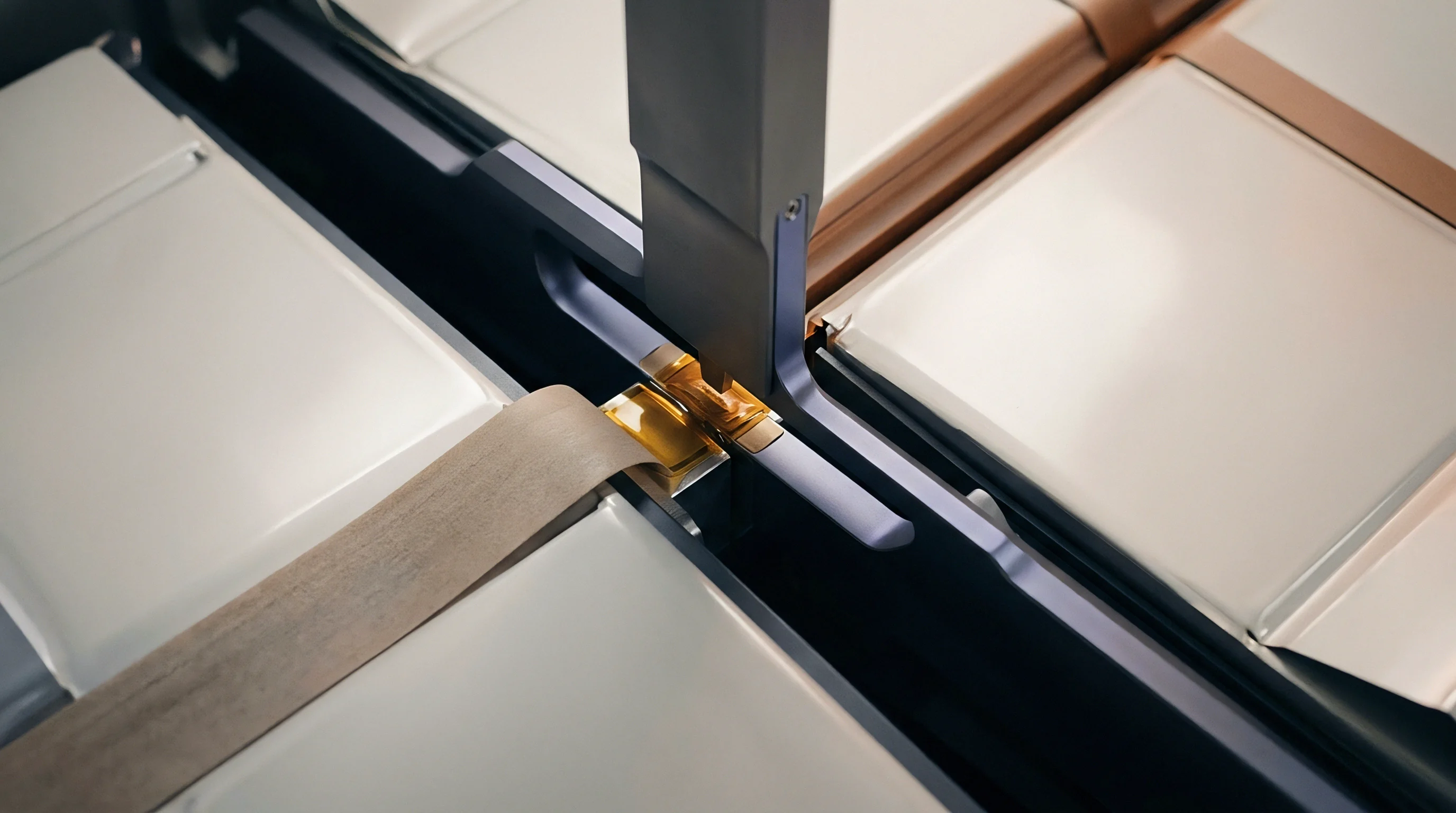
Stoichiometry
Intermetallic phase evolution at the sonotrode-workpiece boundary is governed by thermodynamic stability and atomic mobility under non-equilibrium thermal cycles. When ultrasonic energy combines with current densities above 80 kiloamperes per square centimeter, the interface between an aluminum tab and a cobalt-cemented tungsten carbide tool forms distinct intermediate phases. Binary reactions between aluminum and cobalt generate brittle compounds including Co2Al9, Co4Al13, and CoAl.
These intermetallic phases exhibit high electrical resistivity and room-temperature fracture toughness values below two megapascals root-meter, promoting premature micro-cracking across the knurl teeth.
As solidus temperatures drop seventy degrees Celsius in copper-to-aluminum tab-to-busbar joints executed under high current density ultrasonic assistance, the sonotrode face encounters cross-contaminating interdiffusion from the workpiece itself. Pure copper and aluminum react across five equilibrium phase regimes: theta-CuAl2, eta2-CuAl, zeta2-Cu4Al3, delta-Cu9Al4, and gamma1-Cu3Al. The formation sequence initiates with theta-CuAl2 at 393 kelvin under combined vibrational shear and current, transforming into brittle delta-Cu9Al4 when local temperatures exceed 620 kelvin.
The phase shifts alter electrical and mechanical interface dynamics, as detailed in the measured reaction characteristics below.
| Stoichiometric Phase | Formation Energy (kJ/mol) | Vickers Hardness (HV 0.1) | Resistivity (µΩ·cm) | Fracture Toughness (MPa·m¹/²) |
|---|---|---|---|---|
| Co2Al9 | -34.2 | 680 | 42.5 | 1.8 |
| CoAl | -55.1 | 820 | 28.0 | 2.4 |
| CuAl2 (theta) | -18.4 | 540 | 18.2 | 2.1 |
| Cu9Al4 (delta) | -21.6 | 710 | 31.5 | 1.3 |
| W2C (sub-carbide) | -26.8 | 2200 | 78.0 | 3.5 |
Microcracks propagate through brittle intermetallics as the formation of delta-Cu9Al4 introduces severe volumetric mismatch stresses, accompanied by a 6.2 percent lattice contraction relative to the parent face-centered cubic matrices of copper and aluminum. This contraction generates tens of megapascals of residual tensile stress along the perimeter of the sonotrode knurl teeth. Concurrently, tungsten carbide grains undergo partial surface decarburization under high current pulse spikes, transforming stoichiometric WC into brittle ditungsten carbide W2C.
The coexistence of intermetallic Co-Al phases and sub-stoichiometric W2C degrades the structural integrity of the tool knurl.
The progression of phase transformations follows five observable shifts during tab processing:
- Initial solid solution saturation occurs within the first 30 milliseconds as aluminum atoms dissolve into the interstitial sites of the cobalt binder phase under intense Soret thermal gradients.
- Metastable aluminide precipitation nucleates Co2Al9 along the cobalt-tungsten grain boundaries, increasing local hardness while lowering electrical conductivity across the knurl tooth plateau.
- Phase conversion to ordered CoAl develops as sustained current densities drive interface temperatures above 580 kelvin, consuming the ductile metallic binder.
- Workpiece back-reaction deposits brittle Cu-Al binary phases onto the sonotrode tooth valleys through thermomigration, filling mechanical clearance flutes with low-ductility debris.
- Secondary grain boundary micro-cleavage initiates under cyclic acoustic loading, fracturing degraded carbide clusters along the embrittled intermetallic boundary networks.
A sonotrode operating with more than four percent surface area covered by Cu9Al4 loses twenty percent of its acoustic energy transfer efficiency.
As cobalt binder leaching weakens carbide grains, the rate of intermetallic phase growth under current-assisted ultrasonic welding surpasses standard furnace diffusion growth rates by more than two orders of magnitude. Vibrational shearing continually disrupts embryonic planar intermetallic layers, dispersing sub-micron intermetallic fragments into the bulk tab matrix. This constant renewal of fresh contact interfaces maintains high diffusion flux across the boundary.
The unresolved thermodynamic question remains whether vacancy super-saturation driven by high-frequency acoustic dislocation generation accelerates the chemical reaction rate constants independently of macroscopic Joule heating.

Pickup
Is Tungsten Carbide Binder Depletion Preventable?
Material adhesion onto the knurl contact surfaces compromises sonotrode life and pack joint repeatability. The phenomenon of workpiece pickup involves mechanical adhesion, micro-welding, and atomic diffusion of tab metals directly onto the tool teeth. In standard tab welding lines running pure aluminum 1050 foil packs, aluminum adheres aggressively to uncoated sonotrodes.
Under high current density operations, this pickup layer undergoes severe plastic shear while conducting thousands of amperes. The adhered aluminum layer oxidizes rapidly between consecutive weld cycles, introducing an erratic variable series resistance into subsequent production welds.
Once aluminum deposits into the valleys between knurl teeth, effective tooth height drops. Loss of tooth depth reduces mechanical gripping friction against the upper tab, promoting macro-sliding rather than internal shear deformation through the foil stack. The welding process shifts from internal plastic deformation to uncontrolled frictional sliding at the sonotrode-tab interface, with contact resistance jumping ten milliohms.
Surface melting occurs, producing splash defects that expel molten metal flakes into the battery cell casing.
Knurl cleaning intervals must match the pickup rate to prevent tab burn-through during current-assisted ultrasonic welding.
Tool coatings suppress pickup mechanisms by modifying interfacial surface energy and chemical affinity. Physical vapor deposition coatings such as titanium aluminum nitride, chromium nitride, and diamond-like carbon create diffusion barriers that interrupt thermomigration pathways. A titanium aluminum nitride layer held at a thickness between two and four micrometers isolates the cobalt binder in WC-Co sonotrodes from direct metallurgical contact with reactive aluminum workpieces.
However, the cyclic high-frequency acoustic strain generated during ultrasonic operation imposes high shear fatigue onto coated boundaries. Cracking or delamination of thin PVD coatings exposes the substrate, concentrating current density and accelerating localized pitting erosion.
| Substrate and Treatment | Mean Cycles Before Severe Pickup | Pickup Mass at 50,000 Cycles (mg) | Coating Adhesion Critical Load (N) | Acoustic Resonance Stability |
|---|---|---|---|---|
| WC-6Co (Uncoated) | 12,500 | 14.8 | Not applicable | Shifts +180 Hz from mass loading |
| WC-6Co with TiAlN PVD | 68,000 | 2.1 | 65 | Stable within ±25 Hz |
| WC-10Co with CrN PVD | 45,000 | 4.6 | 52 | Stable within ±40 Hz |
| GlidCop AL-15 (Uncoated) | 8,000 | 22.4 | Not applicable | Shifts +320 Hz from severe deformation |
| Ti-6Al-4V with DLC | 28,000 | 6.2 | 38 | Shifts -90 Hz from compliance changes |
When weld coupons fail automated tensile shear inspection, line maintenance teams often point to tab material variability, improper foil cleaning, or inconsistent nickel plating thickness, though tip pickup frequently stems from thermal duty cycles during production rather than metallurgical incompatibility between the tool alloy and the workpiece.

Replacement
Tooling economics in battery pack manufacturing depend on balancing sonotrode replacement intervals against the cost of pack scrap and production downtime. A single ultrasonic sonotrode manufactured from micro-grain tungsten carbide costs between 1,200 and 3,500 dollars, depending on geometric complexity, internal cooling channels, and proprietary horn mount fittings. When current-assisted processes reduce mechanical sonotrode wear by fifty percent, they simultaneously accelerate chemical wear via thermomigration and intermetallic embrittlement.
Facilities that track tool consumption exclusively through cycle counters overlook the silent degradation of electrical and thermal contact resistance.
Because tooling wear dictates total landed pack cost, a commercial pouch cell assembly line producing 24 battery packs per hour with 108 parallel-series tab joints per pack sees sonotrodes execute over 2,500 weld cycles per hour. Under continuous current-assisted operations, an uncoated sonotrode reaches its acceptable wear threshold within 40,000 cycles, demanding tool redressing or replacement every two shifts. Advanced coated tool tips that survive 120,000 cycles reduce annualized tooling expenditure by 180,000 dollars per automated line while eliminating four hours of unscheduled line downtime each week.
Production quality standards require ultrasonic sonotrode replacement when tooth height erosion exceeds twenty-five percent of original drawing dimensions.
Redressing worn sonotrode knurls by electrical discharge machining removes degraded intermetallic reaction layers, though shortening the acoustic horn length causes acoustic impedance to collapse. Machining 0.2 millimeters from the tool face increases the horn natural frequency by approximately 80 to 120 hertz, shifting it away from the optimal system anti-resonance frequency. The transducer booster stack can accommodate minor acoustic shifts by retuning the generator output frequency, but secondary redressing shifts the acoustic node position, sending excessive bending moments back into the piezoceramic rings and causing internal transducer cracking.
Quality agreements for contract battery pack manufacturing specify strict limits on tool life qualification and replacement authorization. Master supply contracts require that automated process monitoring logs dynamically record acoustic power, dynamic resistance, clamping force displacement, and auxiliary current delivery for every single weld cycle. The production warranty clause specifies that joints manufactured using sonotrodes exceeding the qualified cycle threshold or exhibiting knurl tooth erosion beyond 0.05 millimeters are classified as non-conforming product subject to full lot quarantine.